

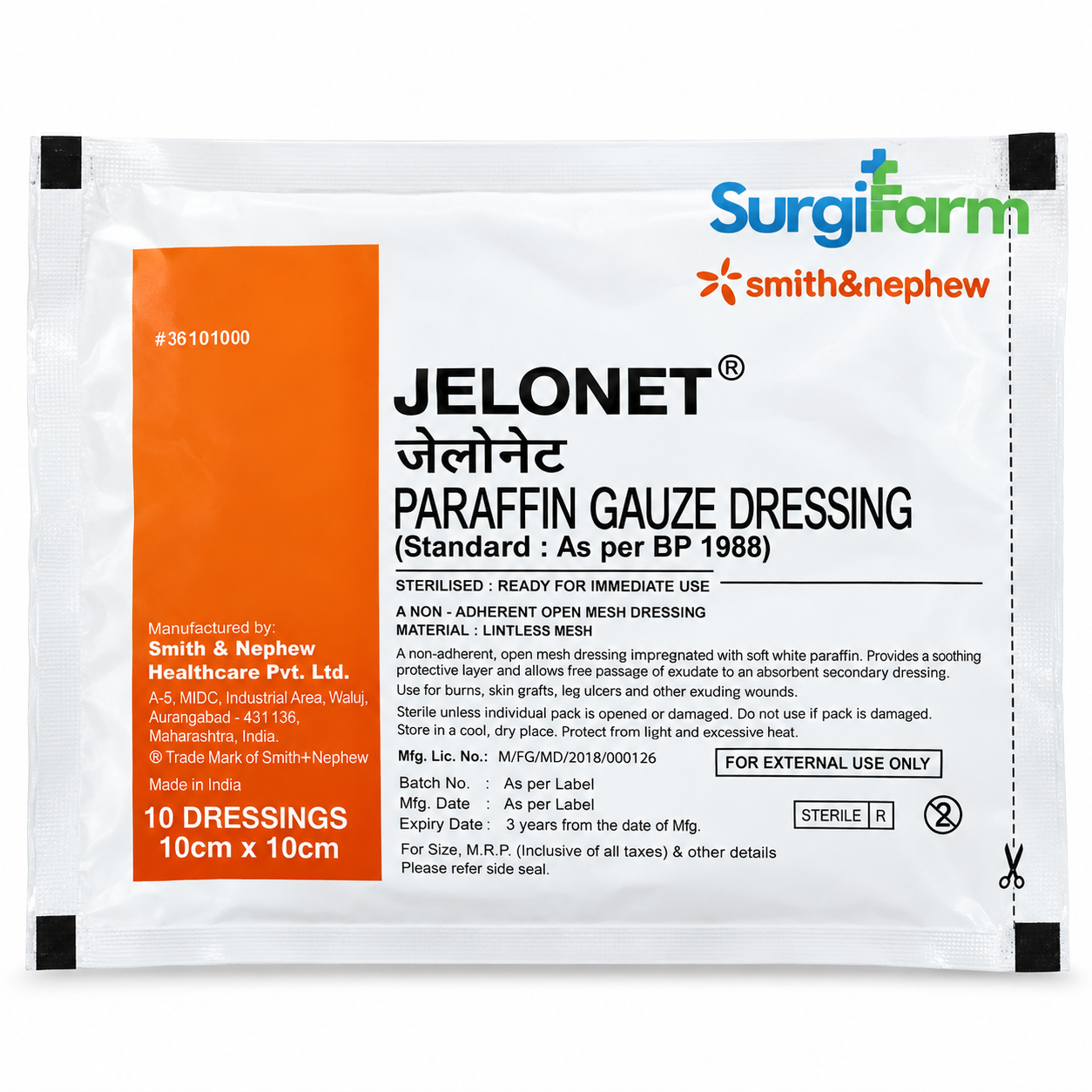
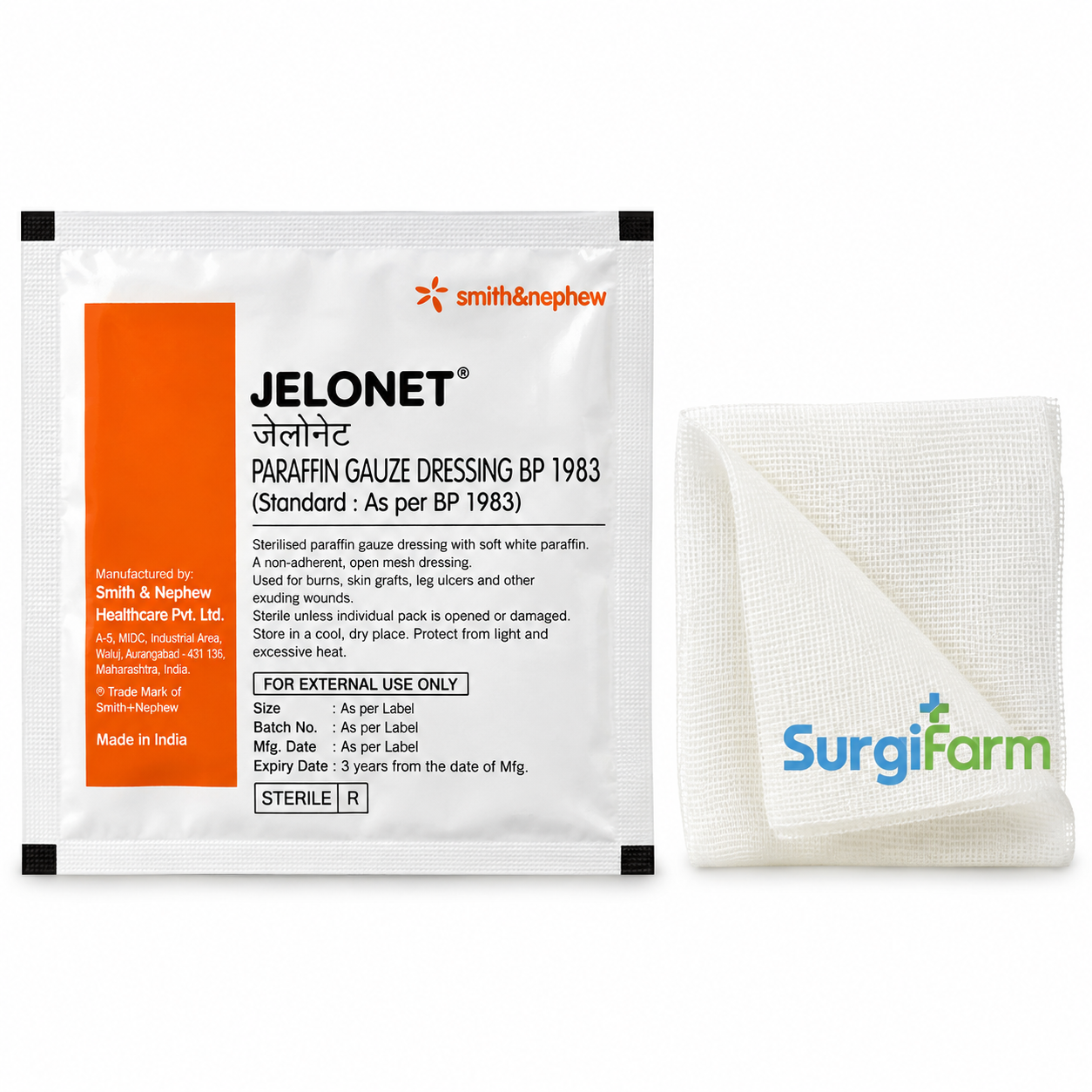
JELONET Paraffin Gauze Dressing – Pouch Pack
Brands: SMITH & NEPHEW
JELONET Paraffin Gauze Dressing – Pouch Pack
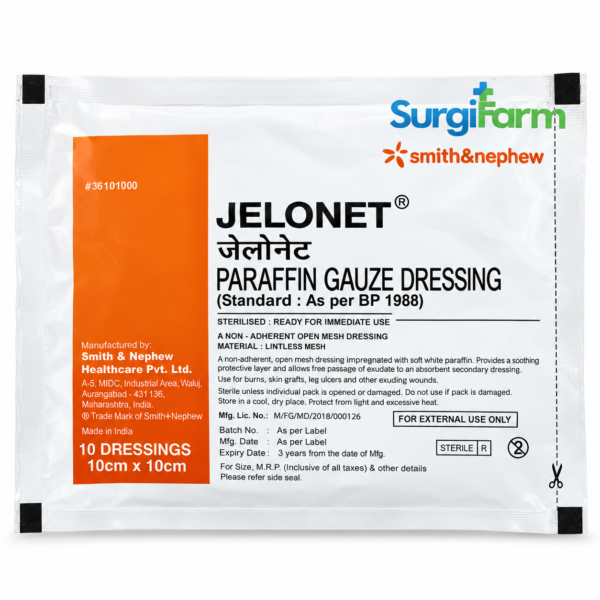
JELONET Paraffin Gauze Dressing – Pouch Pack is a sterile, non-medicated, paraffin-coated gauze dressing designed to provide a low-adherent wound contact layer. It is manufactured for use in wound-care applications where a soft, non-adherent dressing is required. JELONET consists of an open-mesh gauze dressing impregnated with soft paraffin. The paraffin helps reduce adherence between the dressing and the wound surface, which can make dressing changes more comfortable when the product is used appropriately. The open-mesh construction allows wound exudate to pass through into a suitable absorbent secondary dressing. Smith & Nephew The pouch pack provides individually packaged dressing units, helping maintain the sterility of the dressing until the pouch is opened. JELONET is intended for single use and should not be reused. Smith & NephewWhat Is JELONET Paraffin Gauze Dressing?
JELONET is a paraffin gauze dressing used as a primary wound-contact layer. Unlike an ordinary dry gauze dressing, JELONET is impregnated with soft paraffin, creating a low-adherent interface between the gauze and wound. The dressing is non-medicated, meaning it does not contain an incorporated medicinal active ingredient. This allows it to be used as a wound-contact dressing and, where clinically appropriate, alongside a topical medication selected by a healthcare professional. The open-mesh design allows wound fluid to pass through the dressing and into an absorbent secondary dressing rather than being intended to provide the complete absorbency layer itself.JELONET Paraffin Gauze Dressing for Wound Care
Low-Adherent Wound Contact Layer
The soft paraffin coating helps reduce adherence of the gauze to the wound surface. This makes JELONET suitable as a wound-contact layer when a low-adherent dressing is required.Soft Paraffin Coating
The gauze is impregnated with soft paraffin, giving the dressing its characteristic low-adherent properties.Open-Mesh Construction
The open-mesh gauze construction allows wound exudate to pass through to an appropriate absorbent secondary dressing.Sterile Pouch Packaging
JELONET dressings are supplied in sterile packaging. The pouch should be inspected before use, and the dressing should not be used if the packaging is damaged or the seal is broken.Key Features of JELONET Paraffin Gauze Dressing
- Sterile paraffin gauze dressing
- Non-medicated wound-contact dressing
- Soft paraffin impregnated gauze
- Non-adherent / low-adherent design
- Open-mesh gauze construction
- Helps soothe and protect the wound
- Allows wound exudate to pass into a secondary dressing
- Individually packaged pouch format
- Designed for single use
- Suitable for appropriate burns, wounds and graft-site applications
- Manufactured for professional wound-care use Smith & Nephew
Applications of JELONET Paraffin Gauze Dressing
JELONET is indicated by the manufacturer for dressing:Burns
It can be used as a wound-contact layer for appropriate burn wounds, including suitable minor burn applications.Skin Graft Sites
JELONET is indicated for appropriate skin graft sites where a low-adherent wound-contact layer is required. Smith & NephewSkin-Loss Wounds
The dressing can be used for appropriate wounds involving skin loss under suitable clinical guidance.Chronic Wounds
The manufacturer also identifies chronic wounds such as leg ulcers and pressure sores among the indications for JELONET dressing. Smith & NephewHow JELONET Paraffin Gauze Works
JELONET is designed to sit directly over the wound as a primary contact layer. The soft paraffin helps reduce the tendency of the dressing to adhere directly to the wound surface. Because the dressing is an open mesh, wound exudate can pass through into a suitable absorbent secondary dressing. This means JELONET is generally used with a secondary absorbent dressing when required, rather than being relied upon as the sole absorbent layer. Smith & NephewHow to Use JELONET Paraffin Gauze Dressing
Use JELONET according to the instructions provided by the manufacturer and the direction of a qualified healthcare professional.- Wash hands before and after the dressing procedure.
- Gently clean and dry the wound and surrounding skin as appropriate.
- Open the sterile pouch carefully.
- Remove the dressing and handle it by the edges.
- Remove the backing papers according to the product instructions.
- Gently place the JELONET dressing over the wound in a single layer.
- Cover with an appropriate absorbent secondary dressing when required.
- Secure the dressing using a suitable bandage or medical tape. Smith & Nephew
Important Storage and Safety Information
Keep the pouch sealed until the dressing is required for use. Do not use the product if the pouch is damaged or its seal is broken. Store the product in a dry place and protect it from excessive heat and direct sunlight. Follow the storage conditions stated on the product packaging. For serious wounds, significant burns, infected wounds or wounds that are not healing normally, seek appropriate medical attention.JELONET Paraffin Gauze Dressing Sizes
JELONET is available in several sizes and pack configurations. Smith+Nephew’s product information includes sizes such as 5 × 5 cm, 10 × 10 cm, 10 × 40 cm and 15 cm × 2 m roll, with different carton quantities depending on the SKU. Smith & Nephew Indian listings also currently show 10 × 10 cm and 10 × 30 cm variants, while a pouch listing is available for 10 × 10 cm dressings. Therefore, for your Surgifarm listing, I recommend keeping the main product name as JELONET Paraffin Gauze Dressing – Pouch Pack and adding the exact size/quantity as a WooCommerce variation if your inventory has multiple pouch configurations.Why Choose JELONET Paraffin Gauze Dressing?
JELONET is designed specifically as a paraffin gauze wound-contact dressing. Its soft paraffin coating and open-mesh structure provide a low-adherent interface while allowing wound fluid to move toward a secondary absorbent dressing. The sterile pouch format also makes individual dressing units convenient for healthcare facilities and wound-care applications. For hospitals, clinics, nursing facilities and medical-surgical suppliers, JELONET can be maintained as part of a specialized wound-care inventory alongside absorbent dressings, gauze, bandages and medical tapes. For verified manufacturer information, sizes and clinical product information, visit the official Smith+Nephew JELONET product page. Smith+Nephew – JELONET Paraffin Gauze DressingProduct Information
| Specification | Details |
|---|---|
| Brand | JELONET |
| Manufacturer/Marketer | Smith+Nephew |
| Product Type | Paraffin Gauze Dressing |
| Dressing Type | Non-adherent / low-adherent |
| Material | Open-mesh gauze with soft paraffin |
| Medicinal | Non-medicated |
| Sterility | Sterile |
| Packaging | Pouch |
| Usage | Single use |
| Application | Wound Care & Dressing |
| Exact Size | Verify SKU/pack |
Frequently Asked Questions
What is JELONET Paraffin Gauze Dressing used for?
JELONET is used as a low-adherent wound-contact dressing for appropriate burns, graft sites, skin-loss wounds and chronic wounds such as leg ulcers or pressure sores. Smith & NephewIs JELONET a sterile dressing?
Yes. JELONET Paraffin Gauze Dressing is supplied as a sterile dressing. The pouch should not be used if the packaging is damaged or the seal is broken.Is JELONET medicated?
No. JELONET is a non-medicated paraffin gauze dressing.Why does JELONET contain paraffin?
The soft paraffin coating helps provide a low-adherent wound-contact layer and helps reduce the dressing sticking to the wound surface.Does JELONET absorb wound fluid?
JELONET’s open-mesh construction allows wound fluid to pass through to an appropriate absorbent secondary dressing. It is therefore not intended to replace the secondary absorbent dressing when one is required. Smith & NephewIs JELONET reusable?
No. JELONET is intended for single use only and should not be reused or resterilized. Smith & NephewWhat sizes are available?
JELONET is available in multiple sizes and configurations, including 5 × 5 cm, 10 × 10 cm, 10 × 40 cm and 15 cm × 2 m roll in Smith+Nephew’s published product information. Smith & NephewWhat does “Pouch Pack” mean?
A pouch pack refers to individually packaged dressing units. The exact number of dressings per pouch/box depends on the particular JELONET SKU. For example, an Indian listing identifies Ref. 87120003 as a pouch containing 10 dressings of 10 × 10 cm.₹299.00 Original price was: ₹299.00.₹55.00Current price is: ₹55.00.
JELONET Paraffin Gauze Dressing – Pouch Pack is a sterile, non-medicated paraffin gauze dressing designed as a low-adherent wound contact layer. Its soft paraffin coating helps reduce adherence to the wound surface while allowing wound fluid to pass through to an absorbent secondary dressing. It is supplied in a convenient pouch format for single-use wound-care applications.
Description
JELONET Paraffin Gauze Dressing – Pouch Pack
JELONET Paraffin Gauze Dressing – Pouch Pack is a sterile, non-medicated, paraffin-coated gauze dressing designed to provide a low-adherent wound contact layer. It is manufactured for use in wound-care applications where a soft, non-adherent dressing is required. JELONET consists of an open-mesh gauze dressing impregnated with soft paraffin. The paraffin helps reduce adherence between the dressing and the wound surface, which can make dressing changes more comfortable when the product is used appropriately. The open-mesh construction allows wound exudate to pass through into a suitable absorbent secondary dressing. Smith & Nephew The pouch pack provides individually packaged dressing units, helping maintain the sterility of the dressing until the pouch is opened. JELONET is intended for single use and should not be reused. Smith & NephewWhat Is JELONET Paraffin Gauze Dressing?
JELONET is a paraffin gauze dressing used as a primary wound-contact layer. Unlike an ordinary dry gauze dressing, JELONET is impregnated with soft paraffin, creating a low-adherent interface between the gauze and wound. The dressing is non-medicated, meaning it does not contain an incorporated medicinal active ingredient. This allows it to be used as a wound-contact dressing and, where clinically appropriate, alongside a topical medication selected by a healthcare professional. The open-mesh design allows wound fluid to pass through the dressing and into an absorbent secondary dressing rather than being intended to provide the complete absorbency layer itself.JELONET Paraffin Gauze Dressing for Wound Care
Low-Adherent Wound Contact Layer
The soft paraffin coating helps reduce adherence of the gauze to the wound surface. This makes JELONET suitable as a wound-contact layer when a low-adherent dressing is required.Soft Paraffin Coating
The gauze is impregnated with soft paraffin, giving the dressing its characteristic low-adherent properties.Open-Mesh Construction
The open-mesh gauze construction allows wound exudate to pass through to an appropriate absorbent secondary dressing.Sterile Pouch Packaging
JELONET dressings are supplied in sterile packaging. The pouch should be inspected before use, and the dressing should not be used if the packaging is damaged or the seal is broken.Key Features of JELONET Paraffin Gauze Dressing
- Sterile paraffin gauze dressing
- Non-medicated wound-contact dressing
- Soft paraffin impregnated gauze
- Non-adherent / low-adherent design
- Open-mesh gauze construction
- Helps soothe and protect the wound
- Allows wound exudate to pass into a secondary dressing
- Individually packaged pouch format
- Designed for single use
- Suitable for appropriate burns, wounds and graft-site applications
- Manufactured for professional wound-care use Smith & Nephew
Applications of JELONET Paraffin Gauze Dressing
JELONET is indicated by the manufacturer for dressing:Burns
It can be used as a wound-contact layer for appropriate burn wounds, including suitable minor burn applications.Skin Graft Sites
JELONET is indicated for appropriate skin graft sites where a low-adherent wound-contact layer is required. Smith & NephewSkin-Loss Wounds
The dressing can be used for appropriate wounds involving skin loss under suitable clinical guidance.Chronic Wounds
The manufacturer also identifies chronic wounds such as leg ulcers and pressure sores among the indications for JELONET dressing. Smith & NephewHow JELONET Paraffin Gauze Works
JELONET is designed to sit directly over the wound as a primary contact layer. The soft paraffin helps reduce the tendency of the dressing to adhere directly to the wound surface. Because the dressing is an open mesh, wound exudate can pass through into a suitable absorbent secondary dressing. This means JELONET is generally used with a secondary absorbent dressing when required, rather than being relied upon as the sole absorbent layer. Smith & NephewHow to Use JELONET Paraffin Gauze Dressing
Use JELONET according to the instructions provided by the manufacturer and the direction of a qualified healthcare professional.- Wash hands before and after the dressing procedure.
- Gently clean and dry the wound and surrounding skin as appropriate.
- Open the sterile pouch carefully.
- Remove the dressing and handle it by the edges.
- Remove the backing papers according to the product instructions.
- Gently place the JELONET dressing over the wound in a single layer.
- Cover with an appropriate absorbent secondary dressing when required.
- Secure the dressing using a suitable bandage or medical tape. Smith & Nephew
Important Storage and Safety Information
Keep the pouch sealed until the dressing is required for use. Do not use the product if the pouch is damaged or its seal is broken. Store the product in a dry place and protect it from excessive heat and direct sunlight. Follow the storage conditions stated on the product packaging. For serious wounds, significant burns, infected wounds or wounds that are not healing normally, seek appropriate medical attention.JELONET Paraffin Gauze Dressing Sizes
JELONET is available in several sizes and pack configurations. Smith+Nephew’s product information includes sizes such as 5 × 5 cm, 10 × 10 cm, 10 × 40 cm and 15 cm × 2 m roll, with different carton quantities depending on the SKU. Smith & Nephew Indian listings also currently show 10 × 10 cm and 10 × 30 cm variants, while a pouch listing is available for 10 × 10 cm dressings. Therefore, for your Surgifarm listing, I recommend keeping the main product name as JELONET Paraffin Gauze Dressing – Pouch Pack and adding the exact size/quantity as a WooCommerce variation if your inventory has multiple pouch configurations.Why Choose JELONET Paraffin Gauze Dressing?
JELONET is designed specifically as a paraffin gauze wound-contact dressing. Its soft paraffin coating and open-mesh structure provide a low-adherent interface while allowing wound fluid to move toward a secondary absorbent dressing. The sterile pouch format also makes individual dressing units convenient for healthcare facilities and wound-care applications. For hospitals, clinics, nursing facilities and medical-surgical suppliers, JELONET can be maintained as part of a specialized wound-care inventory alongside absorbent dressings, gauze, bandages and medical tapes. For verified manufacturer information, sizes and clinical product information, visit the official Smith+Nephew JELONET product page. Smith+Nephew – JELONET Paraffin Gauze DressingProduct Information
| Specification | Details |
|---|---|
| Brand | JELONET |
| Manufacturer/Marketer | Smith+Nephew |
| Product Type | Paraffin Gauze Dressing |
| Dressing Type | Non-adherent / low-adherent |
| Material | Open-mesh gauze with soft paraffin |
| Medicinal | Non-medicated |
| Sterility | Sterile |
| Packaging | Pouch |
| Usage | Single use |
| Application | Wound Care & Dressing |
| Exact Size | Verify SKU/pack |
Frequently Asked Questions
What is JELONET Paraffin Gauze Dressing used for?
JELONET is used as a low-adherent wound-contact dressing for appropriate burns, graft sites, skin-loss wounds and chronic wounds such as leg ulcers or pressure sores. Smith & NephewIs JELONET a sterile dressing?
Yes. JELONET Paraffin Gauze Dressing is supplied as a sterile dressing. The pouch should not be used if the packaging is damaged or the seal is broken.Is JELONET medicated?
No. JELONET is a non-medicated paraffin gauze dressing.Why does JELONET contain paraffin?
The soft paraffin coating helps provide a low-adherent wound-contact layer and helps reduce the dressing sticking to the wound surface.Does JELONET absorb wound fluid?
JELONET’s open-mesh construction allows wound fluid to pass through to an appropriate absorbent secondary dressing. It is therefore not intended to replace the secondary absorbent dressing when one is required. Smith & NephewIs JELONET reusable?
No. JELONET is intended for single use only and should not be reused or resterilized. Smith & NephewWhat sizes are available?
JELONET is available in multiple sizes and configurations, including 5 × 5 cm, 10 × 10 cm, 10 × 40 cm and 15 cm × 2 m roll in Smith+Nephew’s published product information. Smith & NephewWhat does “Pouch Pack” mean?
A pouch pack refers to individually packaged dressing units. The exact number of dressings per pouch/box depends on the particular JELONET SKU. For example, an Indian listing identifies Ref. 87120003 as a pouch containing 10 dressings of 10 × 10 cm.Customer Reviews
Reccomended Products
Online Sports Nutrition and Natural Dietetics.
Chances are there wasn't collaboration, communication, and checkpoints, there wasn't a process agreed upon or specified with the granularity required. It's content strategy gone awry right from the start. Forswearing the use of Lorem Ipsum wouldn't have helped, won't help now. It's like saying you're a bad designer, use less bold text, don't use italics in every other paragraph. True enough, but that's not all that it takes to get things back on track.
The villagers are out there with a vengeance to get that Frankenstein
You made all the required mock ups for commissioned layout, got all the approvals, built a tested code base or had them built, you decided on a content management system, got a license for it or adapted:
- The toppings you may chose for that TV dinner pizza slice when you forgot to shop for foods, the paint you may slap on your face to impress the new boss is your business.
- But what about your daily bread? Design comps, layouts, wireframes—will your clients accept that you go about things the facile way?
- Authorities in our business will tell in no uncertain terms that Lorem Ipsum is that huge, huge no no to forswear forever.
- Not so fast, I'd say, there are some redeeming factors in favor of greeking text, as its use is merely the symptom of a worse problem to take into consideration.
- Websites in professional use templating systems.
- Commercial publishing platforms and content management systems ensure that you can show different text, different data using the same template.
- When it's about controlling hundreds of articles, product pages for web shops, or user profiles in social networks, all of them potentially with different sizes, formats, rules for differing elements things can break, designs agreed upon can have unintended consequences and look much different than expected.
This is quite a problem to solve, but just doing without greeking text won't fix it. Using test items of real content and data in designs will help, but there's no guarantee that every oddity will be found and corrected. Do you want to be sure? Then a prototype or beta site with real content published from the real CMS is needed—but you’re not going that far until you go through an initial design cycle.


Reviews
Clear filtersThere are no reviews yet.